Thursday, 30 January 2014

Learning outside the classroom.

"The use of places other than the classroom for teaching and learning", quote from Archibald McLeish.

Learning outside the classroom creates links to what we learn inside the classroom because its sometimes difficult to teach effectively without the right surroundings. It uses surroundings and the community to create a framework for learning while developing further their skills and knowledge.

For example, it's ok to show pictures of a house, a block of flats and a post office but when they go on what they would call 'an adventure' or 'a day out', they remember the differences better because they actually the building with their own eyes!

Children between the ages of 3 an 7 are at their most curious stage so it is the best time to get out of the classroom and explore and learn from a first hand experience of what nature has to offer.

Learning outside the classroom builds bridges between the theory and the reality. It develops personal and social skills. The children can also be more aware of what dangers there are in the world outside the safety of the school premises, being taught to hold hands with your partner and look left/right before crossing the road. They gain responsibility through this and it prepares them for the geographical side of their future studies.
I believe in this cross-curricular idea, I think its brilliant that it mixes it up from just being in the classroom and motivates children to go out and explore with things that are natural. why not count apples on real trees instead of laminated apples on a cardboard tree. Feel the leaves, look at the different colours and the different types. It maintains their interest when they are given new and exciting things to do.
One task I remember doing at school was choosing a location and making that chosen location into a framed picture using materials. I chose Parc Howard Mansion in Llanelli, I used twigs and real leaves that I collected when we visited and I used foil for the steps because the steps were grey. If we think back to real life learning we have done and think how it made us feel to go and do these exciting things, it must be right to continue it and share the excitement.
I think that Physical Education (PE) is one of the best subjects to have in education because it keeps children active and teaches them a variety of new skills that they can apply to everyday life especially in future occupations. PE doesn't involve written work but still requires the children to focus and follow basic instructions. They can run freely, learn rhythm and coordination by simply throwing a tennis ball back and fourth. It helps with numbers if for example you were measuring the distance of how far a ball was thrown or the amount of laps you were to run.
Learning outside the classroom should be made compulsory for at least an hour a week. It could be something that they look forward to and motivate from and would have a massive impact on every child's education, in my opinion.

Sand play!


Learning through play

By observing a child during play we can access a child's knowledge and skills to determine how a child learns best so we can give them the needs they acquire to progress.
Dramatic play helps the child play with their language and make stories through role play relating to real life situations.
By leaving a box of costumes in the dramatic area, the children  can get into a character costume and start building on their imagination while also exploring different outcomes and realities of real life situations.
They also develop their communication through cooperation with other children and build their confidence at the same time.
By acting out different scenarios the are understanding and learning what things are, such as certain names for different furniture or names of different occupations.
For example, in a restaurant scene, they can practice taking orders which develops self esteem and communication skills, they deal with money handling and quantity of items they might order. They learn to respect others, express personality and help to tidy up at the end of a session.

Role play is not the only play children learn from. Children learn through their senses which brings me on to sand play and water play. Children love to touch things simply because they like to feel the different textures. I think sand and water in schools is a brilliant way to learn because there is so much you can do with them. It is like a science lesson through play. It lets the children see smooth sand change to a damp sand castle by adding water. They can learn measurements of water or the weight of sand before and after it has been added to water and its hands on messy fun.

Vygotsky is a theorist that believed in learning through play. He believed children could construct their own knowledge and understanding by socialising and interacting with other learners in a fun and interesting environment. Society is the main reason for learning  through play because tools have been created and introduced in schools such as maps, letters, symbols, numbers, tables and models.
'The child's knowledge is co-constructed through social interaction' so their 'word bank' is progressively built on through play by using words such as "more", "stop", "again".
The more they use these words, especially in role play, the will develop their imagination and communication and start to use this intrinsically. This will develop independently. Thy realise and understand what they have experienced with others and make a mental map. I agree with Vygotsky's theory because without anything from society to process and map in their mind, how are they to think of these things and know what to do with the information. By learning through play they are practicing what they have learnt applying it to other sociological situations.

"The child is a collaborative learner, not a lone scientist", quote from Lev Vygotsky.

The Foundation Phase.

By taking part in lots of different practical activities, children will  learn and develop all the essential skills and education they need for further education, hence being called the 'foundation phase' because it is a foundation for children to develop from. The foundation phase is for children aged between 3 and 7 years of age and aims to meet the diverse needs of children. This is the most important time for learning basic skills that they will need in their lifetime. They are given problems which they need to solve physically rather than just writing on paper. The key idea of this phase is 'doing' through the idea of play so Welsh Government states that they will be given opportunities where they will have a first hand experience which can continuously be improved through repetition because they have the foundation of where to start and what to do next time. http://wales.gov.uk/topics/educationandskills/earlyyearshome/foundation_phase/?lang=en
There are many different aspects of the foundation phase such as mathematics, reading, writing, problem solving, communication and the welsh language.
There are Seven Areas of learning:
  1. Personal and Social Development, Well-Being and Cultural Diversity
  2. Language Literacy and Communication Skills
  3. Mathematical Development
  4. Welsh Language Development
  5. Knowledge and Understanding of the World
  6. Physical Development
  7. Creative Development
The first area relates to learning in the real world. It includes relationships with other people and other ethnicities, learning to respect each other equally. It is also based on the importance of an individuals confidence and motivation. A child's well being is associated with aspects such as basic needs like security, warmth and how at ease they are with themselves and their surroundings.
I believe well being is essential for a learner because they need to be comfortable and confident with their surroundings and the people they associate with, in order to thrive from education and be motivated to work to the best of their ability.
A child's personal development can be improved through independent opportunities such as eating, dressing, going to the toilet and so on. I think that if children learn independence from a young age when it is most important, they will be become more mature and developed adults later on and have the confidence to achieve greater things.
The second are is key for communication and expression of ones thoughts and feelings.
Children communicate through stories, role play and movement to name a few.
Language is also a major tool for cognitive development and how thy process their thoughts. Their speaking, listening, reading, writing and communication skills develop from this area. Without this, children would find it difficult to pronounce certain words, learn how to put letters together to read/write also, we would find it difficult to identify it a child has a disability such as dyslexia.
I believe this encourages children to have a broader imagination and be more involved in active play. It will make them more confident and contribute more during group activities.
I think Mathematical development needs to be fun and colourful but most importantly, it needs to be meaningful. I found that using cards with different numbers and animals helped a lot because they could relate a real life thing to a number. It is important that the learner is given time to work out the solution incase they become frustrated and feel like a failure.

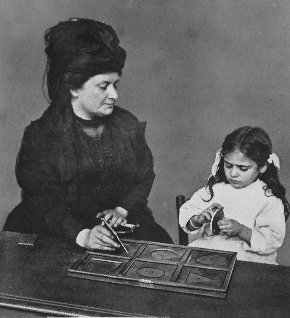
Montessori Philosophy


"I have studied the child. I have taken what the child has given me and expressed it and that is what is called the Montessori method." quote from Dr. Maria Montessori.


Dr.Maria Montessori worked at a Mental Asylum in Rome caring for children. Through watching the children playing with bread and manipulating the bread into what they wanted, Montessori thought that if she could get something the could play with and manipulate, thy might develop better skills. She was influenced by Edouard Seguin's work on sensory education and was the first to put his work into practice. She designed practical developmental materials for the children in the asylum and within these more complex materials were a series of tasks that Montessori believed helped the children control their own errors and understandings.

This is the idea of children working freely but with joy and responsibility, as individuals, in an environment where the children can be more active, using their hands and doing physical things. Its a more effective way for them to learn at their own pace. It is hands on, visual, practical learning!
The Montessori Method educates children on life skills and expects them to be able to help with the cooking, washing/cleaning at home, learning to dress/undress themselves. One of those learning blocks in education is learning how to get a long with different people of different ages. Throughout life you are surrounded by different people of all ages especially in higher education. Montessori believed that a classroom with a multi-age setting works best because it is similar to a family setting which makes individual learning comfortable.

The children perform self-directed learning where they make their own decisions such as how they spend their time, what they do in that time and what there are learning. This doesn't mean their free to waste time. The adults are in the classroom to make sure the child is using their time well and are working on things that they need to work on to progress throughout the different levels of the education system.
There are different activities that can be used in this method. The children freely play with the items placed around the classroom by the teacher and manipulate these items but are learning independently at the same time.
An example of a mathematical method is using a sequence of different diameter cylinders and slotting them in to the different sized spaces. Montessori believed that these kind of physical tasks educated the child's eye to recognise mathematical sequences. Children learn by doing.
The children are practising life skills at an early age meaning the children learn to be in charge of their own learning and this is something they can use for the rest of their lives. The result of the Montessori method is that the children leave school with skills such as calmer problem solving, solid social skills, solid academic skills and the eagerness to learn new things!